Are You a Quitter?
What Substack, books, and attention have to do with each other
Lately, I’ve been quitting more than usual. I quit books that don’t pull me in fast enough. I quit TV series everyone swears will “get good if you just stick with it.” I’m trimming my podcast queue, too. Shows that once hooked me just don’t land anymore.
There’s a strange kind of liberation in quitting. I never used to feel that. The rule‑follower in me treated quitting like a moral failure. And when I didn’t love something the zeitgeist insisted was brilliant, I assumed the problem was me. Why wasn’t I drawn to it?
A year and a half ago, I proclaimed that Substack was making me a terrible reader. I’m sharing that essay again because the question still nags at me:
Is this platform helping or hurting our ability to read real books — and to write the books and essays we keep promising ourselves we’ll get to?
Yesterday I had lunch with two friends I met in sobriety. When we get together, it goes deep. One friend shared how she discovered, in adulthood, that she has ADHD. I shared how my therapist, on more than one occasion, suggested I get some testing. In our sessions, she has gently alluded to the fact that I present as a woman who has masked and managed her fragmented attention for many years and could benefit from some deeper understanding of it. My son has an official diagnosis, and I’m told there is a genetic component. It presents much differently in females, so my antenna was up the entire conversation with my friend yesterday.
I bring this here, with another glance at this essay, because I am curious if others feel this and may not even have words for it.
Is Substack capturing my mind or is my mind simply wired to wander?
I have a confession: Substack is turning me into a terrible reader. There. I said it.
Despite diligent toggling and untoggling in the settings section of this platform, my mind pulls me back here way more than I anticipated when I first signed up. None of the publications I subscribe to go to my email inbox. Those guardrails are up. I receive zero notifications on my phone if I have “activity” here on this platform. I have to willingly go seek an essay, scroll the Notes section or deliberately check the metrics.
And yet, it still seems to have dug its claws in me. It drags me back; daily.
Undeniably there is lots of reading to be had here. Lots (so many!) terrific writers who share such compelling essays. So how, you might ask, is my time here turning me into a “bad” reader?
Because, I have a pile of real, actual books that are collecting dust. Books I know I will love but that I can’t seem to gain any traction in once opening.
Why?
Because I think Substack is hacking my attention. It has become the replacement reels, the quick hit. The let me read one more then I’ll go and do XYZ. Except XYZ no longer includes really staying with and absorbing a book. At least not lately.
I came to this platform feeling so refreshed after the grossness I felt spending time on other social media platforms. Landing here was fresh exaltation, ahhhhh. It felt like a warm bath for the mind. And it was. And still is, most days.
I love the creative variety you find when you show up here. There is a vast literary menu to choose from, depending on what you are hungry for reading. And I have definitely landed on essays that STAY with me and get me to think.
But it isn’t the same as finishing a book. A book you don’t want to end because you feel like you KNOW the characters. A book you can’t believe you didn’t write yourself because GAH(!) that is how I think/that is my life experience, too. A book you hope will be made into a movie because I want more!
AND…….
It isn’t the same as finishing a book because a book requires deep focus. Sustained reading that transports you and sustains you for more than 12 minutes.
This shift of awareness made me revisit a book that I did sit and read and devour back in 2022:
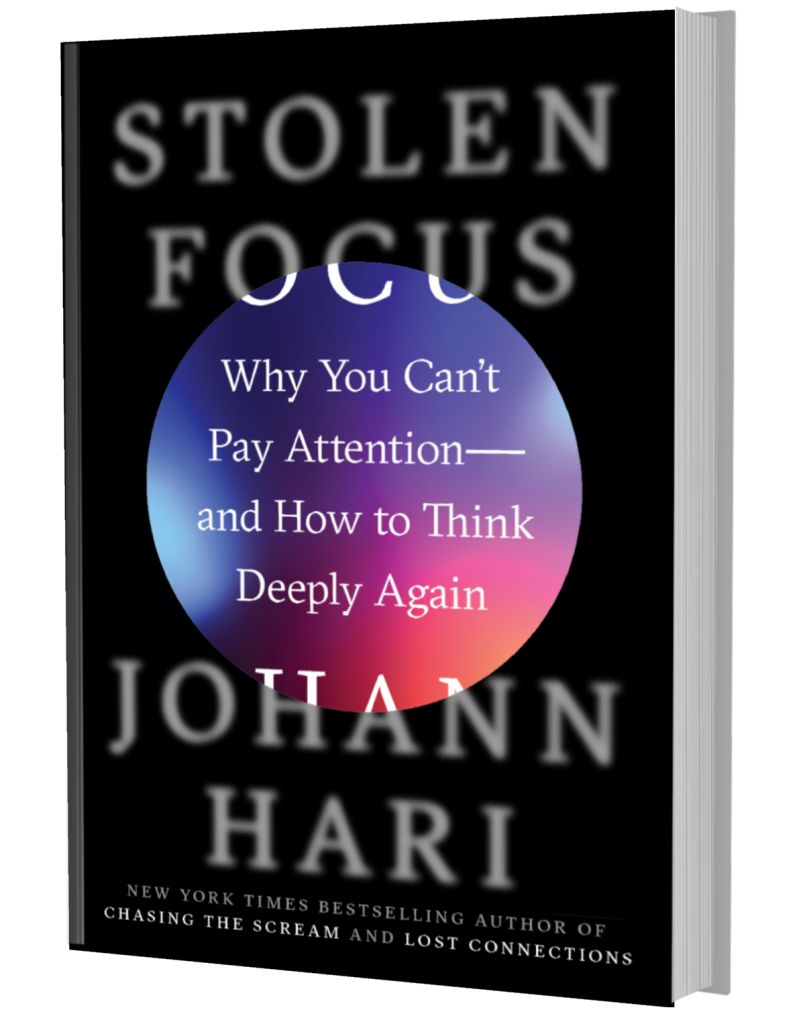
Despite the book’s impression on me, my mind still loses in the game of sustained concentration. I know I’m not alone in this. And that doesn’t comfort me. It actually scares me. Because the water we are swimming in collectively is slowly eroding sustenance. Slowness has been deemed a flaw. Patience is fleeting. We’ve been programmed to swipe and click and scroll and move onto the next thing. The waves of distraction pull and lure us away from really swimming in the deep end. The thing is our minds can swim the distance. That’s what makes us humans so incredible. Yet, we act like squirrels.
It’s an infinite scroll. There’s always more to find on Google. There is no THE END to social media or the internet. We scurry away for the next click or interface. No ending or closing up like that of a book.
On the medium of books and literature, Johann Hari writes:
“What, I wondered, is the message buried in the medium of the printed book? Before the words convey their specific meaning, the medium of the book tells us several things. Firstly, life is complex, and if you want to understand it, you have to set aside a fair bit of time to think deeply about it. You need to slow down. Secondly, there is a value in leaving behind your other concerns and narrowing down your attention to one thing, sentence after sentence, page after page. Thirdly, it is worth thinking deeply about how other people live and how their minds work. They have complex inner lives just like you.”
There are many writers here whose words do slow me down (in the best of ways), whose words I want to savor because they layer their essays with complexity. And then there’s the comment section which is wonderful and engaging. It’s just that once I get a taste of that, I want more. So, I pinball my way through artistry here, swiping my inbox for another hit. Rather than sitting with the words I just read. It’s reflexive not reflective.
There’s a statistic in Hari’s book that states, 57 percent of Americans now do not read a single book in a typical year. This makes me sad, so sad. And again, scared.
There is definitely a buzz to online conversations that you don’t get it a book. You see it here in the comment sections. A book isn’t an interface that you can click into in real time.
For a while I thought it was pretty cool that I could bounce in and out of books. For the last year or so I’ve regularly juggled 3-4 books at a time. Dipping in and out of each one depending on my mood. I tell myself that this is easy to do with nonfiction, which is what I mostly read. Now, though, when I really step back and examine this, I can see and admit that it is more than that. I don’t even think it’s that.
The hard truth? I can’t focus long enough to stay IN a book, no matter how well written. And I’m concerned. It is taking me so much longer to finish a book. I’m not relishing books the way I used to.
Is it just me?
What it all comes down to, I think, is speed. We can’t stand the idea of “wasted” time.
In his book, Hari interviews physicist Sune Lehmann about the increase in perceived speed in our society (for all things):
“There’s this thing about speed that feels great…. Part of why we feel absorbed in this is that it’s awesome, right? You get to feel that you are connected to the whole world, and you feel that anything that happens on the topic, you can find out about it and learn about it.” But we told ourselves we could have a massive expansion in the amount of information we are exposed to, and the speed at which it hits us, with no costs. This is a delusion: “It becomes exhausting.” More importantly, Sune said, “what we are sacrificing is depth in all sorts of dimensions…. Depth takes time. And depth takes reflection. If you have to keep up with everything and send emails all the time, there’s no time to reach depth.
No time to reach depth. From our endless to-do lists, the litany of reasons we all slap on our “I’m so busy” badge like it’s a contest, and the way our society expects everyone to respond to all the things so damn fast, ugh. Enough. Let the text messages sit there unanswered. You have not failed if you didn’t answer every email today at work. The laundry and dishes CAN go unattended for another day.
We are all so hard on ourselves. We are so focused on the knee jerk reaction of speed. We pull that lever over and over because, well, yeah. It often feels good. If feels great to cross those things off the list, to be productive, to crush your day, to connect online with people and feel that hit of dopamine.
I’m just here asking; wondering, what is all this costing us?
And then there’s the actual effect of reading on a screen versus reading on a page. Like an actual paper in your hand page (do you remember what that feels like?)
Reading books trains us to read in a particular way - in a linear fashion, focused on one thing for a sustained period. Reading from screens trains us to read in a different way - in a manic skip and jump from one thing to another. We’re more likely to scan and skim when we read on screens. Studies have found we run our eyes rapidly over the information to extract what we need. But, after a while, if we do this long enough, the scanning and skimming bleeds over. It also starts to color or influence how we read on paper. This becomes our default.”
~Anne Mangen, professor of literacy at University of Stavanger in Norway
Here it is. My default setting is sticking it’s tongue out at me as I try to sit with and stay with a book. My brain is confused, searching for the key facts, the bullet quotes, the parts that are in bold and different font.
You know, like they are in every essay on Substack you open. Like they are here in this one.
Screens are contaminating my relationship with the page.
Imagine what it is doing to our kids? Their brain development.
I think the most concerning paragraph to me in Stolen Focus is this one:
In losing our ability to read long texts we are also losing our cognitive patience and the stamina and the ability to deal with cognitively challenging texts. When I was at Harvard conducting interviews, one professor told me that he struggled to get his students there to read even quite short books, and he increasingly offered them podcasts and YouTube clips they could watch instead. And that’s Harvard (!)
If Harvard has to compromise and come to its knees because their students lack deep focus, where does that leave the rest of us?
I feel like one day in the not-so-distant future we will be talking to our grandchildren saying, “well, you know back in my day we used to have to hold books in our hands and turn pages and sit there by ourselves to ingest the story and the plot.” The future’s version of trekking through the knee-deep snow for 4 miles to get to school story of elders.
And then there’s the “move on” effect. Our collective attention “moves on” to the next tragedy, the next natural disaster, the next school shooting. The constant stream of it all has a way of desensitizing some of it to some of us that it all comes across as surreal or just “old” news.
I recognize that’s the influence of our media outlets- they want to constantly roll out new stories, a roulette wheel of catastrophic events. Take your pick. Where will you land today?
Idling is necessary though. Stay tuned a bit longer and perhaps see how you can help.
Also, since I’m here confessing all the ways I fear my brain is deteriorating, I’ll just keep going. One of the side effects of publishing this weekly newsletter is it feels like I’m in a state of perpetual rehearsal with what I’ll be writing next. Rather than resting in the essay I just finished and shared, I’m onto the next one. This isn’t presence. It feels performative.
Now, instead of taking pictures and posting on Instagram to show followers, look at this. Look at where I am, look at what is lighting me up. Isn’t it lighting you up too? I’m out wandering in nature voice texting myself the fragments of thoughts that come to me that I know will make for a compelling essay. I do my writing while walking. I’m future casting to my draft page here. I think about how I can word my next piece to draw you all in. Rather than drop into my senses in my setting I am setting up my “next one.” I am not where my feet are. I am still here. On the screen.
Aren’t our brains cute? Funny little neurons, right?
When I spew and lecture about how bad the “other” social media is (just ask my kids), am I just being morally righteous to think this is better? Is this that much different than continuously posting on Facebook, TikTok or Instagram? Just because it is a long form share.
I’ve decided I will view Substack as harm reduction. The lesser of two evils, if you will. The feed here does feel less harmful. The community here is definitely less hurtful. There’s vastness and variety that feels impossible on other platforms.
So, I’ll keep coming back. And I hope you will, too.