My Inner Mentor. And the other "M" word.
Lately, my life feels choreographed by hormones. Stay with me men. You should read this too because I bet there is a woman in your life you love that has to take this dance floor.
There is a moment when men—and let’s be honest, our culture is shaped largely by their comfort—tend to look away when the topic of menopause is brought up. Menopause is still treated as an aside, a punchline, or a private inconvenience rather than a profound biological and social transition. Disengaging from it doesn’t make it smaller; it makes women carry it alone. If we can make room for conversations about productivity, leadership, and longevity, we can make room for the realities that shape half the population in midlife. Turning toward menopause to listen without fixing and to stay present without minimizing is not a courtesy. I truly believe it’s a civic and relational responsibility.
Menopause is not a private inconvenience or a women-only footnote. It is something men witness in their homes, in partners they live alongside, in colleagues they work beside. And as sons and husbands, it is something they will one day recognize in the women they love.
And me? Why do I feel pulled to write about this? I am moving through menopause just as my twelve-year-old daughter is entering puberty, and our days have taken on the strange intimacy of a shared tide. We are both being pulled and pushed by forces we didn’t invite, learning new currents inside familiar bodies.
Some mornings we orbit each other carefully, aware of the volatility in the air. Other days we collide with tears appearing without warning. With irritation rising faster than language leaks. There is tenderness in it, too. A mutual recognition that neither of us is fully in control. That something ancient is rearranging us from the inside out.
We are getting so used to it that we now jokingly call each other out on it.
When my emotions suddenly boil and fill to the top or I can’t remember a word or where I put my keys, Caroline will place her hand on my back, “Menopause, mom.”
When she vomits her frustrations all over me because of everything she is asked to do in a single day or she feels the need to retort every damn suggestion that I softly lob her way, she catches herself and says, “Puberty, mom.”
And then we both smile.
Levity. It really matters. Especially in the landmine of parenting.
These days, our hormonal shifts braid together. Mine asking me to release, hers insisting she arrive. We are both becoming someone new at the same time, under the same roof, often in the same moment.
And it’s not lost on me. I have been familiar with the parallels of parenting in real time. Watching my daughter at different iterations brings me back to my own 12-year-old self. There are beautiful openings where I learn to reparent myself. Lately, though, I feel I am shifting and visiting a different version of myself. One that hasn’t arrived yet but that can still guide me.
Instead of healing my inner child or reparenting myself, I’ve been listening to my inner mentor. The wise elder.
I am in the middle of a slow read of the book, Playing Big by Tara Mohr. In the chapter titled, The Voice of Inner Wisdom, she guides readers through a visualization of your inner mentor (and even provides a link for online access). The reframe offered when at a crossroads in life is “what would my older self do?” The process of slowly entering the visualization prevents it from being just another fantasy about where you want to be in 15 or 20 years. That fantasy reel is not your deeper voice of inner wisdom talking. That’s dopamine and conscious hope swirling around like it always does. I am not someone who ever felt pulled by guided visualizations but this one - this one got me there. It was powerful. I saw my elder face. I heard her speak to me.
Is this midlife pulling at me? Perhaps. Midlife has a way of rearranging the questions. Sobriety does too. Maybe sobriety and midlife entering the stage together has changed the plot for me. This doesn’t feel like a dramatic breakthrough, though. It feels like discernment. It’s about what gets my time, my energy, my attention. What actually deserves me.
I stopped looking at photographs of myself at five or eight, searching for the origin story of my tenderness or my fear. I don’t want to keep orbiting the beginning. Instead, I choose to close my eyes and imagine my face at eighty.
She is calm. She is unseduced by urgency. I ask her what mattered most when the noise fell away. Not what hurt most but what endured.
I ask her where I spent too much time stalling, calling it patience. I ask her where I waited for certainty in a world that doesn’t offer it. Where I confused healing with endless self-monitoring, and preparation with safety.
I ask her about the money I worry over, the energy I ration, the risks I postpone while telling myself I am being responsible. I ask her what I will obsess over that never happens—and what happens anyway, sober and clear-eyed, without my consent.
She doesn’t shame me. She doesn’t ask me to excavate every wound. She simply points to the places where I showed up awake. To the relationships that required presence instead of performance. To the days I thought were ordinary but were, in fact, my life.
The elder version of me knows this: attention is a currency. So is fear. So is hope. Every day I am spending something, whether I mean to or not.
In a time of collective uncertainty when the news churns, institutions wobble, and the future feels strangely not mine; her guidance is simple but not easy. Don’t numb. Don’t disappear. Don’t confuse consumption for care or outrage for action.
She isn’t interested in perfection. She cares about aliveness. About integrity when no one is watching. About whether I stayed with what was hard instead of abandoning myself quietly.
Listening to her changes things. It becomes less about repairing the past and more about stewarding what remains. The question shifts from what happened to me? to what am I doing with the time I still have—sober, awake, and unhidden?
And somehow that future voice is the most compassionate one I’ve found. She knows the world will keep changing. She knows fear will always offer itself as a distraction. And she keeps asking me to face forward, not backward, and to live like this moment counts.
The most honest part of it all? Living inside these simultaneous transformations with my daughter has made time feel less linear and more cyclical. In the best way. I can feel my body moving me toward release even as hers pulls her toward becoming. Watching her step into the beginning while I inch closer to an ending has clarified something I couldn’t access before. Wisdom doesn’t always come from rewinding the clock of lived experience. It also comes from listening ahead. This is not me turning my back on the child I once was. This is me holding her hand and together we turn forward, toward who we are becoming. I close my eyes and imagine my face at eighty, steady and ready, and I ask her to help me parent not just my daughter, but my remaining time.
In noodling this all out here on the page, my mind keeps going back to a family party my siblings and I hosted for my mother on her 75th birthday (a few years ago). The party was not a surprise but the video we presented to her was. We gathered clips from family and friends, some many miles away, some down the street. My son edited the video, and we streamed it for my mom on a big sheet outside on a gorgeous summer day.
This was my contribution:
Watching this back, I can’t help but think about myself, someday, as a Matriarch. And I listen to what she has to say to me today.
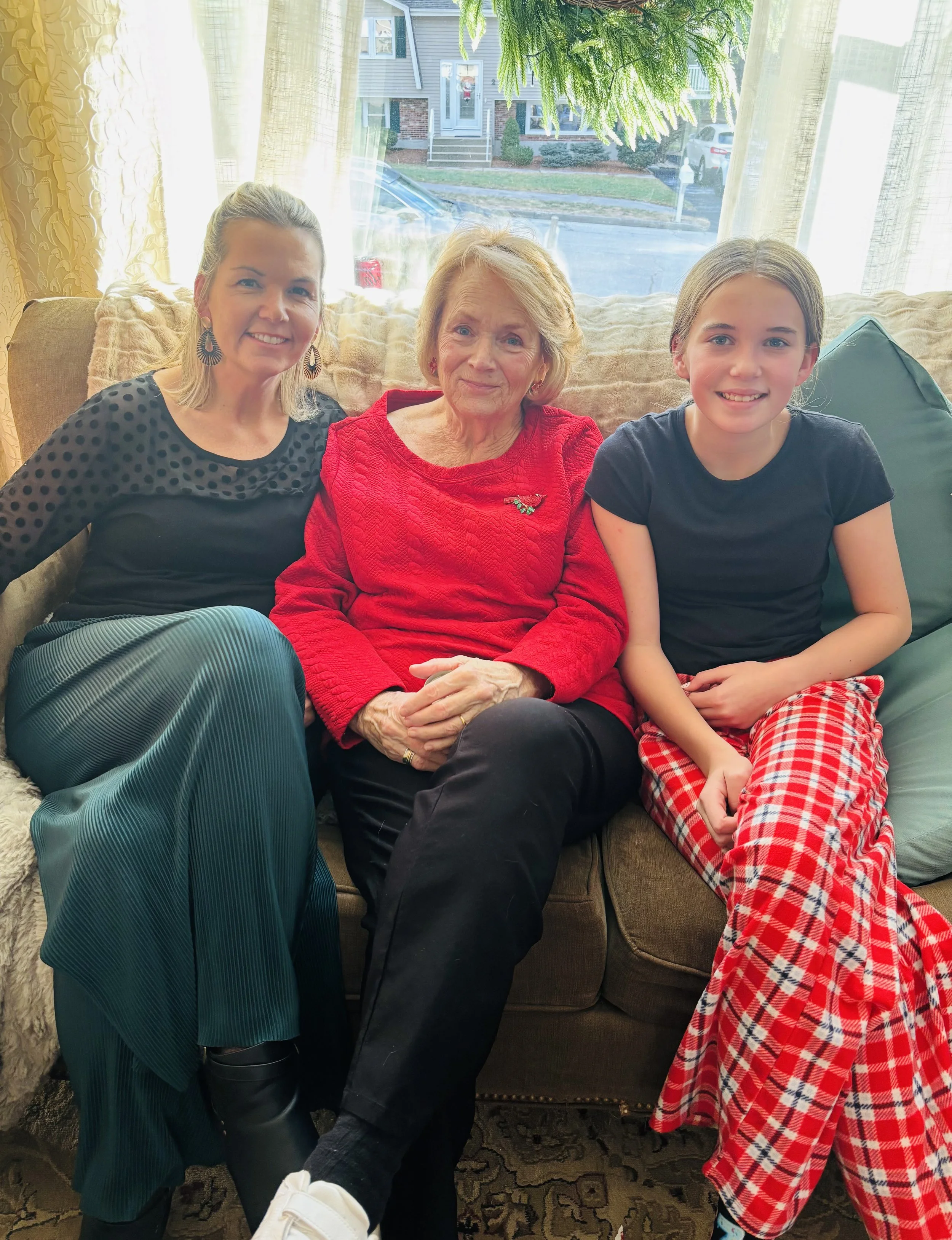
Our Matriarch, my mom, sandwiched between my daughter and me last Christmas.
