When Midlife Rearranges the Marriage
Three weeks ago, I made the following declaration:
I am lonely in my marriage.
I placed that confession down in a community comments section over at Everything Happens with Kate Bowler in response to one of her essays on the pull and ache of Lent. In that space, Kate offered us this:
May you stop apologizing for what aches.
May the truth you name today be held gently—
not rushed, not corrected, not explained away.What is one ache you’ve been minimizing or ignoring? How might it feel to name it without trying to fix it?
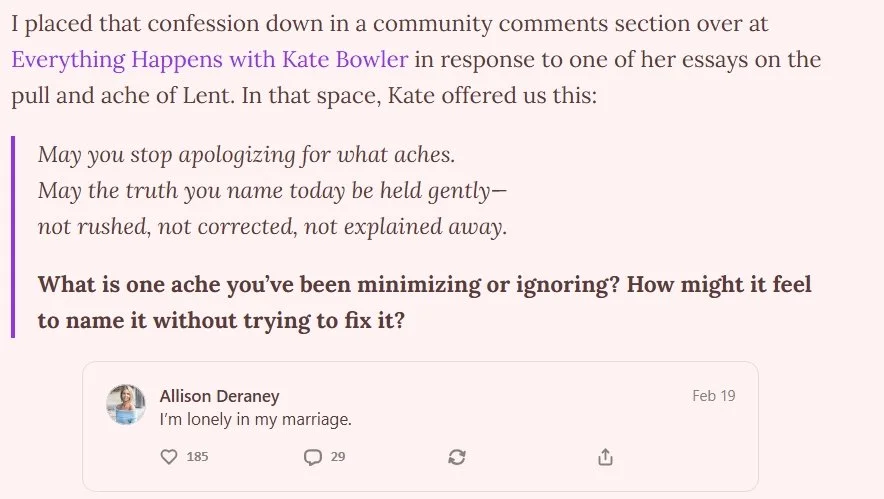
182 people clicked the heart button. 26 iterations of “Oh, you have named my ache” and “me too” and “I appreciate your naming what so many of us are ashamed to admit.”
What is it about admitting this that is so difficult? What are we afraid it might reveal about us? Loneliness lives quietly inside marriages because no one wants to talk about it. What if it didn’t need to stay quiet - the ache? What if naming it openly, not only inside the marriage but also out in the world, could begin to change things?
The loneliness in my marriage has been spoken aloud. My spouse feels it too. We talk about it in the way couples do when they are trying to understand something that arrived gradually, almost invisibly. There was no dramatic fracture, no single moment that explains the distance. Yet somehow a gap has wedged itself between us, and we can’t quite figure out how to bridge it. Despite sweet attempts on both our parts.
Midlife marriages often pass through this strange rearranging. The children who once required constant tending begin to need us less. The shared project of raising them, once the center beam of the house suddenly and silently shifts. Without realizing it, couples can forget how to reach for each other in ways that aren’t logistical or parental. Suddenly the marriage that hummed right along as transactional has become fractional.
And it all happens accidentally. A slow drip spits for years. So quiet that no one hears the leak. But behind it, in the quiet space no one ever sees clearly, moisture gathers for years. Nothing dramatic or egregious pours out, just enough to feed what now grows there. A mold that multiplies in the dark.
On the surface, the structure holds. Bills get paid, roles are performed, routines followed. But behind the façade, where affection and tenderness should live, something begins to rot. Complacent companionship sets in like spores, feeding on every unmet need, every unspoken hurt. By the time the damage shows, the decay has already started eating the frame.
And rebuilding and rehabbing feels really hard. Like, where’s the blueprint for this?
At the same time, something else is happening beneath the surface for many wives. As women move toward menopause, the internal landscape changes. Hormones shift, sleep slips away, identity swings us in new directions. A biological and psychological turning inward.
Menopause invites women to reconnect with themselves after decades of outward focus. The gaze shifts. Gears change. The body craves a different orientation. Quiet reflection alone. More solitude. And we leave men in the dark about this. We assume they can’t handle this conversation.
Why?
Time alone has become a necessity for me. The stillness and the solo treks give me something I could not access until recently: the ability to hear myself clearly. For perhaps the first time, I am communicating well - with myself.
A woman hiking up the menopause mountain while honoring her sobriety? Well, that’s a recalibration like no other. Because those two forces are grabbing the megaphone and insisting I listen.

A photo my husband captured of me after we reached the summit of a mountain in Bartlett, New Hampshire.
Menopause begins stripping away the hormonal cushioning that once helped smooth over discomfort, conflict, and emotion. At the same time, sobriety removes the chemical buffer that once dulled feeling and softened the edges of reality. What’s left is a kind of double clarity.
The Polaroid snapshot of my lived life right now feels over exposed. I am holding it in my hand, gently shaking it so that I can see it all for what it is.
It can feel disorienting because the same questions arise from both forces:
Why am I suddenly unwilling to tolerate what I used to? Why does silence feel heavier yet necessary? Why do my feelings arrive so directly now?
Sobriety demands honesty. Midlife insists on authenticity. Together they create a powerful collision that can feel like upheaval. Unless and until you remember - it is a catalyst.
Many women describe it as waking up in a house they built suddenly seeing every room clearly. Dust bunnies and all.
So, the question: Is this catalytic thrust menopause or is it sobriety? almost seems pointless. I tell myself to drop the insistence that I label or explain this away.
But I can’t ignore how I felt after I received the results of a recent endocrine blood panel. I opened the portal, read the results and then had a laugh with my husband. All the crazymaking circles of questions I dizzied myself over in my head can stop now. Because I was handed chemical proof that biology is at play here, not pathology.
I can stop flagellating myself, spinning the daily roulette wheel wondering if it will land on black or red. Is today going to hand me an anxiety sandwich or sober soup of sobbing? Is this menopause manipulating my mood or is it the full throttle feeling of a life lived sober?
Oh wait, maybe this is simply me feeling exactly what makes sense right now.
What a relief.
In thinking about all this, I came across this quote last week:
All of humanity’s problems stem from (wo)man’s inability to sit quietly in a room alone.”
― Blaise Pascal
I am at a point in my life where I crave aloneness.
And I tinker on isolating others. Texts go unanswered. I accept less invitations to social outings. I tell myself and others that this is what protecting my energy looks like.
But could it be a swirl of more than that?
Research on solitude suggests that intentional time alone can support emotional regulation and self-reflection, allowing people to process thoughts that otherwise get drowned out in the noise of daily life. Psychologists distinguish this kind of chosen solitude from loneliness; it can be restorative, even clarifying. It has been that for me. It is that for me.
Yet the same stillness that sharpens my self-awareness has also created a kind of stagnancy in how I communicate with others. I am internally naming things now instead of numbing them. Dancing with my emotions instead of distracting my day around them. The thoughts rise more readily, the feelings more precisely labeled. This has for sure reduced their intensity. Clearly, that’s a positive.
And naming something internally is not the same as acting on it externally.
So, things accumulate. We can spend years holding things in until suddenly the problem is not silence but volume. Too many realizations, too many feelings finally asking to be acknowledged. Thoughts float by like clouds, practicing patience. Until one day the sky is too overcast to ignore.
Something has to rain down.
And this is where I think many spouses become confused. From their vantage point, the woman beside them seems to be withdrawing. She wants more walks alone. More quiet evenings. More interior space. Except what looks like distance may actually be recalibration. A woman learning, perhaps for the first time in decades, how to listen to her own inner weather pattern. Without running for shelter.
The thing is, though, when relationships live between two atmospheres eventually the questions become unavoidable:
Which cloud needs clearing the most?
Which one carries the most turbulence?
Which one is ready to break open?
Solitude can be healing. It can restore the self that was stretched thin across years of caregiving and responsibility. And solitude also has a shadow side. The inward turn can become isolation.
When does the quiet we need begin to feel like abandonment to the person beside us?
Maybe it happens in the small, unspoken moments—when our retreat becomes a habit, when our silence stops being a refuge and starts becoming a wall. Or maybe it happens long before that, in the instant we forget that solitude is a choice we make for ourselves, but connection is a promise we make to someone else. The truth is, we are always balancing on that thin edge between tending to our inner world and tending to the people who share our outer one. I don’t think that tension will ever go away for me. And perhaps that’s the point. It doesn’t need to. Because I can hold a vow to myself and to my husband. Because I don’t want to slip away from him, or me.
